


Not every mark on a precious-metal object belongs to the usual sequence of responsibility, locality, fineness, year and control marks. This page brings together mis-strikes, transitional markings, supplementary marks, import marks and marks whose meaning remains unresolved.
First examine the complete sequence and compare recognisable marks with the site's other reference pages. An unusual mark may be an owner's name, a maker's internal number, a fineness mark from an export market, or simply an imperfect strike.
When the usual interpretation does not fit
Errors and anomalies
A mark may be incorrect, struck twice or date from a change between systems. An anomaly alone does not mean that the object is not genuine.

Old control and year marks in 1810
A spoon marked by Gustaf Granfelt of Porvoo bears the three-crown control mark from the period of Swedish rule and the old-system year mark D3.
The object was probably marked at the very beginning of 1810, before the new single-crown control punch was ready and before the Finnish year-mark series beginning with A was adopted.

W5
The letter W is not used in the Finnish year-mark series, so this should not be interpreted as a Finnish year mark.

Double crown
The first control mark missed its intended position, so the crown was struck again.

Double locality mark
The locality mark was struck twice in slightly different positions.

Fineness 79
The fineness marks 84 and 78 were used from 1853 to 1891. The mark 79 was never officially in use.

813H, UH and 750
Other marks were accidentally struck on this silver spoon in place of the locality and year marks.
Beyond the standard mark sequence
Owner's, commemorative and supplementary marks
These marks may indicate an owner, hand craftsmanship, material, size or a maker's internal tracking system.

Millennium commemorative mark
Inspecta Oy's voluntary commemorative mark identified jewellery and jewellery collections made in 2000. It was applied only to articles tested and control-marked in accordance with the regulations.
The mark was designed by master goldsmith Pia-Mari Laamanen. In the photograph it appears last in the sequence.

G.SIDOROW
The owner's name G.SIDOROW was added to the spoon after the standard mark sequence.

Double marking CG + AK
The goldsmith's widow Carolina Granbom continued the workshop in Porvoo from 1858 to 1867 and used the responsibility mark CG. This 1864 spoon also bears an unidentified AK mark, probably the personal mark of the journeyman who made it.

Precious Metals Office mark
The EL monogram lies between the control and fineness marks. It was used on certain inspected articles from 1980 to 1986, during Elsi Lindahl's tenure as head of the Precious Metals Office.
The marks of Lindahl's successors appear as numbers 235 and 304 in Tukes's register of pictorial responsibility marks.

Hand-made
This supplementary mark emphasises that the object was made by hand.

Suomenlinna
A goldsmithing business based in Suomenlinna uses the widely recognised Suomenlinna emblem as a supplementary mark resembling a locality mark.

Sundqvist
In the 1930s, the Sundqvist brothers used an octagonal Finnish-origin mark above their full-name mark. Introduced in 1932, it was developed by Kotimainen työ ry and drawn by Matti Björklund, later known as Visanti.

Internal stock number
Some makers marked their products with an internal shop number. It linked the object to a record containing details such as the price of the work, stones, weight, drawing number and the smith who made it.

Wood anemone
The wood-anemone mark used on EcoAct silver developed by Sirokoru and Diacast was introduced in 2008. The alloy has a fineness of 965 parts per thousand, but the articles bear the statutory 925 fineness mark.

Spoon size
In the 1890s, the Helsinki goldsmith Fagerroos used numbers to indicate the size of small spoons: for example, 0 = 126 mm, 2 = 133 mm and 4 = 140 mm.
Sequences combining several systems
Import and transitional marks
An imported object may bear marks from its country of origin as well as marks added in Finland. Changes in regulations have also left overlapping systems on some objects.

HjF – imported object from 1907
The foreign-made silver object has a fineness of 830, and 2487 is the maker's model or serial number. Finland used the 813H silver fineness mark in 1907, so the importer Fagerroos added Finnish marks to the object.
The control mark still has the ordinary heart-shaped outline. The oval control mark for imported goods came into use in 1925.

Pd · A. Tillander
Oy A. Tillander Ab used the Pd mark on palladium jewellery before palladium became a precious metal covered by the hallmarking regulations in 2009.

PT · A. Tillander
Oy A. Tillander Ab used the PT mark on platinum jewellery before platinum became a precious metal covered by the hallmarking regulations in 1977.

925S
A piece of jewellery made for export by Kupittaan Kulta bears the Norwegian silver fineness mark 925S.

Two fineness marks
A silver spoon marked in 1892 bears both the old 13L luoti fineness mark and the 813 millesimal mark introduced that year.

Heart-shaped marks
Konstantin Liljeström used heart-shaped mark outlines on a spoon made in 1894; the locality mark is in a heraldic shield. Regulations effective from 1895 required a rectangular outline for silver fineness marks and the letter H alongside the numbers.

Finnish and Norwegian marks
On a spoon imported by Suomen Kultasepät Oy, the Finnish marks were struck on both sides of the Norwegian marks. Despite the import inspection, the Finnish 813H fineness mark was omitted.
The sequence shows Suomen Kultasepät Oy, the import control mark, NM for Norwegian design, the Norwegian 830S fineness mark, Thorvald Marthinsen Sölvvarefabrikk's goblet mark, N for Norway, Turku locality mark A and year mark K6 for 1939.

Engraved responsibility mark
On an object import-inspected in Finland, the responsibility mark JE was engraved instead of being struck with a punch.
The foreign 830 fineness mark was overstruck with the Finnish 813H mark, and the foreign maker's mark with the import control mark. Also visible are Helsinki, year mark X5 for 1927 and the unidentified JE.
Research continues
Marks of unresolved meaning
No reliable explanation has yet been found for every recorded mark. These are presented as open observations, not definite identifications.

80
The meaning of this mark has not been established in the current material.

HETTA
Neither the meaning nor the use of this mark has been established in the current material.

L.
The final mark in the sequence on a spoon marked by Suomen Kultasepät Oy in Turku in 1901 is L. Its meaning is unknown.
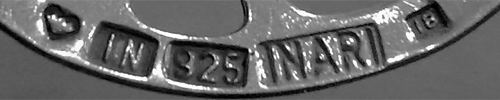
INARI
One small mark, many uses
Dots in marks
There has been no uniform rule governing dots in marks. Their position or number alone therefore cannot determine a mark's identity.


Responsibility marks
Dots and colons occur particularly in the oldest responsibility marks. A dot may be at the foot of the letters or higher, around their midpoint. The same smith could use versions both with and without dots.
In Sortavala, Elias Jokinen used EJ in 1891 and E.J. in 1902. Tillander marks are known as AT, AT. and A.T. A colon could appear between initials, as in G:H and C:G:N, or at the end, as in F.B:.
Year and fineness marks
The earliest year marks were generally undotted, although exceptions are known: Turku used the year mark N.2 in 1846. Dots became more common in year marks in the late nineteenth century and could appear after the letter only, after both letter and number, or after the number only.
In fineness marks, the dot usually followed the numbers, as in 813.H, but it was also used after the letter H, as in 870.H. Dots also occur in locality marks, such as Loviisa's L. mark.