


Leimat.fi celebrated its tenth anniversary in 2020. To mark the occasion, we began publishing stories from the fascinating world of Finnish precious-metal marks. New stories are still added from time to time.
Choose a subject below. Select its heading to open the full story.
Story 01Finland’s shortest-lived location mark?Read the story →

Last summer, while studying old precious-metal marks, the Hallmark Committee found several rare Viipuri location marks. The generally recognised town mark of Viipuri is the letter W. On the earliest marks, a crown appeared above the W; the crown was later removed, leaving only the letter. This is the form in which specialist literature usually presents the Viipuri mark.
The motifs used for location marks came from the coats of arms of the towns concerned. Goldsmiths and silversmiths were originally permitted to work only in towns, so choosing suitable motifs caused no difficulty. Viipuri’s coat of arms, dating from the fifteenth century, showed the letter W with three crowns above it, and this provided the subject for its town mark. In 1817, however, the town received a new coat of arms depicting Viipuri Castle with the familiar W above it. The new arms were not universally popular, and a return to the old design was considered on several occasions.
The rare castle-shaped location mark is based on this later coat of arms featuring Viipuri Castle. Surviving sets of marks show that H. Torvinen Oy (responsibility mark HT) used the castle mark in 1943 and 1944 (year marks O6 and P6), while E. Oksanen Oy used it in 1944 (P6). Oksanen was still using the W location mark in 1943 (O6).
Aarne’s 1942 reference work for goldsmiths, which illustrates the location marks, does not yet include the Viipuri castle mark. It first appeared in Kultaseppien lehti in 1943, when the assay office was reported to have redesigned the location marks because the old ones were unclear. Torvinen probably introduced the new castle mark in Viipuri in 1943, with Oksanen following later. Their marks differ somewhat from the assay office’s model: the W is larger and the proportions are different. The castle mark was short-lived, however, because Viipuri was lost in the fighting in June 1944. The rest, as they say, is history.
Story 02The earliest known responsibility mark used by a Finnish woman—EHERead the story →

Old Finnish silver objects continue to reveal unidentified responsibility marks belonging to the people who made them. Some time ago, a silver sauce ladle made in Kristiinankaupunki in 1867 came to light bearing the previously unknown maker’s initials EHE. Research identified them as Emilia Henriette Eklund, widow of the Kristiinankaupunki goldsmith Carl Wilhelm Eklund, who died in 1866. She continued to run the workshop after his death. This was common practice, although objects made under a widow’s management normally continued to carry her late husband’s existing mark—in this case Carl Wilhelm Eklund’s CWE.
One source names Emilia Henriette Eklund as the first Finnish woman to pass the examination in hallmarking required of precious-metal smiths. This entitled her to register her own mark, EHE. Finland’s first mark issued to a woman was probably used for only a few years, because Emilia married the goldsmith Karl Edvin Rosenblad in 1870. He used the mark KER. Emilia was not the only woman in the family to have a mark of her own: when Emilia and Karl’s daughter Ella Charlotta Rosenblad came of age, she too passed the hallmarking examination, in 1904, and registered ECR.
As if the story were not already complicated enough, the family included a third woman who obtained her own mark at an early date. After Emilia’s death, Karl married Hulda Konstancia Forsman. Karl himself died only a few years later. His widow Hulda continued to run the workshop, passed the hallmarking examination in 1889 and registered HKR. She subsequently married her late husband’s brother, Frans Leonard Roos. Because the initial of her surname remained R, she did not need to alter her mark. After working as smiths in several towns, Hulda and Frans emigrated to the United States at the beginning of the twentieth century. This remarkably intricate family history was uncovered through a single old silver sauce ladle.
Story 03Buying and selling jewellery and silver at auctionRead the story →

Many people are captivated by the beauty of old jewellery and objects. They are well made by skilled craftspeople and, by present-day standards, can even be inexpensive. There is also a very real chance of making a discovery. But where can an ordinary buyer find such treasures?
In recent years, almost every auction house has moved into the digital age, and auctions are now conducted online. This has placed their stock within everyone’s reach: we can browse an enormous selection from the comfort of our own sofas. Once registered as a customer, we can bid online and follow the competition in real time to see whether we win at a price we like.
Prices follow the law of supply and demand, although the value of the raw material still influences estimates for jewellery and silver. The figure shown by an auction house is an estimate, so with luck an object may sell below it. If a lot is especially popular, competitive bidding may drive the price considerably higher. The seller and auction house will almost always have agreed a confidential reserve price below which the item will not be sold. This is often around 20 per cent below the published starting price, although practices vary. In addition to the hammer price—the final bid—the buyer pays a buyer’s premium, commonly around 15–20 per cent.
To sell an object, the customer takes it to an auction-house specialist for examination and valuation. Together they agree the estimate and reserve price. The object is then photographed, and the specialist prepares its description and condition report before it is published online for bidding. This procedure is important because it gives prospective buyers confidence in the item’s authenticity and informs them of its condition and any damage. The auction house usually charges the seller a commission of about 15 per cent of the sale price.
Anyone can, of course, set a price and sell an object themselves without commission through one of the many open auction and marketplace sites online. When the object is a Finnish precious-metal product, Leimat.fi offers a convenient way to check what its marks reveal.
The most important difference between an online marketplace and an auction house is that auction lots have been examined by a specialist. Buyers can therefore be confident that an object is genuine and in the condition described in the report. They also have the right to cancel the purchase if the object does not correspond to its description. Another major advantage, particularly for more valuable objects, is that auction houses reach a broad international audience numbering hundreds of thousands of visitors each day.
Following auctions is an enjoyable hobby, and there is no need to buy anything. Simply browsing what is on offer can be rewarding in itself. Give it a try—you may become hooked.
Story 04From a boat to a Viking shipRead the story →
The first nationwide regulations requiring a location mark on precious-metal objects date from 1596, although the practice became widespread only later. Between 1689 and 1753 the location mark effectively served as the control mark: it was kept by the guild alderman and struck only when an object was inspected. In 1754, the crown became the control mark.
At that time, precious-metal objects could be made only in towns. Towns traditionally had their own coats of arms and seals, which supplied the motifs for their location marks. The first seal of Helsinki, founded in 1550, depicted a fish tail, rather like the motif in the present-day coat of arms of Vantaa. In 1644 it was replaced by the design still used today: a boat floating on water with a crown above it. (Image 1)
According to Tyra Borg, Helsinki’s first goldsmith began work in 1557, before location marks were in use. The earliest known Helsinki mark with the boat-and-crown motif dates from 1759. The design remained substantially unchanged for about a century.
A word of caution: during the nineteenth century, Hamina also used a similar location mark. This is because the coats of arms of both Hamina and Helsinki feature a boat and crown.
After the mid-nineteenth century, the crown above the boat gradually began to disappear. It became smaller and its points came to resemble rowlocks. At the same time, the boat often acquired a rudder and sometimes water beneath it. Many variations exist. (Images 2 and 3)

A small mishap occurred with the location mark on a spoon produced jointly by Airas and Mellin in 1890. Its marks are exceptionally ornate by Finnish standards, but the engraver mistakenly used the coat of arms of Uusimaa instead of Helsinki’s: the familiar boat appears between two wavy ‘rivers’. The mark is known to have been used at least from 1887 to 1894. (Image 4) New model designs for the location marks were probably introduced in the early 1920s, although no precise information has been found in the literature. Helsinki’s mark was shown as a boat with a rudder. As the mark wore, the tiny gap between the rudder shaft and the side of the boat often disappeared, making it resemble a felt boot or shoe rather than a boat. (Image 5)

The strangest design ever used as a location mark is undoubtedly the Viking ship on a spoon imported and marked by Hugo Grün in 1930. The company had already caused surprise a couple of years earlier with a mark that looked remarkably like a woman’s high-heeled shoe or an arrow. The likely explanation is that this Danish importer had its punches made in Denmark, where the engraver did not fully understand what sort of boat sails in Helsinki’s coat of arms. (Image 6) The location-mark designs were revised in 1943 and new model illustrations were published. In practice, however, objects rarely carry a mark that precisely follows the model. More commonly, only the boat is shown, without waves or rowlocks. It may be so highly stylised—almost like a bowl—that it would be difficult to recognise as a boat without knowing what the design was intended to depict. (Images 7 and 8)


Story 05An apprenticeshipRead the story →
Hans Kumlin recalls his path to becoming a goldsmith.
In spring 1959, I graduated from the metalwork course at Sturenkatu Vocational School in Helsinki. After my summer job, I took my school certificate to the Helsinki employment office. When the official suggested a position as a goldsmith’s apprentice, I was very interested and went straight to the firm at the address I had been given.
My knowledge of goldsmithing was limited to what I had seen in shop windows, so the passage behind a shabby door in the dark gateway of the Kihlman building at Korkeavuorenkatu 19 left me rather bewildered. Silversmith Veikko Reinikka and goldsmith Sakari Laine had established the partnership Reinikka & Laine. They were former colleagues from Kaksonen’s workshop. They must have noticed that the workshop came as a surprise to me, but they accepted me as an apprentice.
We agreed on a three-month trial period, after which we could sign an official apprenticeship agreement if they considered me sufficiently promising, reliable and diligent. An apprentice earned 80 marks an hour—about two euros in today’s money. I had a good home life and paid my mother a small amount for food; she always made me excellent packed lunches.
My entire 45-year career in goldsmithing began at eight o’clock the following morning by lighting the cast-iron coal stove. There was no central heating in the room, although Helsinki did have a gas network.
The company had no narrow business concept. We undertook every kind of repair, commission and alteration for retailers and private customers, as well as making badges and plaques for various organisations. Piercing work with a jeweller’s saw certainly tested ‘the boy’, so necessary trips to the precious-metals assay office and other errands were welcome breaks.
My official apprenticeship agreement was signed on 1 February 1960. Completing the vocational school metalwork course shortened the formal apprenticeship by two months. I received the theoretical instruction required for the goldsmith’s trade in spring 1963. At the time, several of us were officially apprenticed students at the Goldsmith School. Kimmo Korpi, a member of the Helsinki Goldsmiths’ Association, attended the same course.
Goldsmith Sakari Laine trained me well. As my skills developed, he gave me progressively more demanding work that helped me improve. He was not an authoritarian master; he always encouraged independent thought and freedom in choosing working methods. He also ensured that my pay rose with my ability. Veikko Reinikka, who used the responsibility mark VR, was responsible for our right to hallmark. He was widely known as an exceptionally skilled silversmith.

In August 1963, assay masters Gustafsson and Karanterä approved the drawing for my practical test. I chose to make a gold cluster ring with a cultured pearl set in platinum at its centre, surrounded by twelve tourmaline-coloured synthetic spinels—I could not afford diamonds. When the piece was half finished, the assay masters visited the workshop to inspect my progress. My employer gave me the gold and platinum for the test piece. After the final inspection, I was told to make myself a pair of gold cufflinks, without skimping on the material, as a reminder of my apprenticeship. Sakari Laine’s instruction was: ‘Make them so well that you will never have cause to regret them.’
My vocational certificate, dated 18 December 1963, arrived by post. The journeyman’s certificate was presented at a much larger ceremony at which apprentices from several trades received their certificates—for some reason not until 13 April 1966.

Overall, I feel that I received broad and excellent training in goldsmithing, which proved enormously valuable throughout the different roles of my career.
I hope this account of my apprenticeship sheds some light on the life of a goldsmith’s apprentice in decades past.
Tuusula, 14 May 2020
Hans Kumlin
Story 06The marks of the Tillander family’s goldsmith businessesRead the story →
Alexander Tillander left Helsingin pitäjä for St Petersburg to learn the goldsmith’s trade. He qualified as a master goldsmith there in 1860 and established his own workshop. Its established mark became the initials AT inside a lozenge.
The business operated in St Petersburg until the revolution of 1917. It succeeded in transferring its stock to Helsinki and resumed trading there in autumn 1918 with its former representative, goldsmith Viktor Lindman. The company was called Lindman & Tillander and used Lindman’s VL responsibility mark.

The company soon passed entirely into Tillander ownership. Its name became A. Tillander and the familiar AT returned as its responsibility mark. During the following decades, AT was used on lozenge-, oval- and rectangular-shaped punches. The long horizontal mark A.TILLANDER also appeared from time to time.


Tillander had manufactured decorations and medals since 1919. During the Second World War, this work was undertaken by its subsidiary Kunniamerkkitehdas Oy, which used the responsibility mark KMT, usually inside a lozenge.

After the war, Koruteollisuus Tillander Oy took responsibility for industrial jewellery and badge production. It adopted a combined T motif resembling an aerial inside a triangle. The workshop attached to the company shop continued to use the traditional AT mark until 1980.

The triangular mark was abandoned in 1973 and industrial production returned to a lozenge mark containing a newly designed AT monogram. At the same time, the company became Oy Tillander Ab. A diamond-shaped T motif was also registered to the company. In 1977 Herbert Tillander sold a majority of the shares in Oy Tillander Ab to its management. The entire company was sold to Armas Puolimatka in 1984. In 1994 it moved from Helsinki to the former premises of Kupittaan Kulta in Turku. The Konttinen family bought the company from Raimo Puolimatka in summer 2008.

After Tillander’s industrial operation was sold in 1977, the Aleksanterinkatu shop and its workshop initially continued under the owner’s name, Herbert Tillander Oy. A few years later the company became Oy A. Tillander. Following financial difficulties, it changed its name to Helsingfors Top-Juvel Ab in 1992 and went bankrupt under that name. The family bought the assets from the bankrupt estate and resumed trading as Oy Alexander Tillander Ab, but soon sold the business to new owners. Between 1977 and 1993 these companies used the initials HT inside a lozenge. Today the company uses both the long horizontal mark ATILLANDER and a lozenge containing the superimposed letters AT.
Goldsmith Torbjörn Tillander left the family firm in 1956 and established Atelier Torbjörn Tillander in Helsinki. The business used the mark TT; the initials were later placed inside the lozenge familiar from other Tillander marks. After Torbjörn’s death in 1992, the handcrafted jewellery business passed to his daughters, Annette and Tina Tillander.

They ran it together until 2007, when Annette Tillander established a business of her own, although she continues to own half of Oy Atelier Torbjörn Tillander Ab. Annette Tillander’s own company uses the responsibility mark ATT.
Story 07A history of Finnish hallmarkingRead the story →
Finland has a long tradition of marking valuable gold and silver. Precious-metal fineness standards were already precisely regulated in the fifteenth century. In 1485, goldsmiths and silversmiths were ordered to mark the objects they made with their initials, allowing the authorities to ensure that smiths did not use alloys below the required fineness.
Pure gold and silver are too soft for jewellery and practical objects. Mixing other metals—most often copper—into the precious metal during melting produces a more usable and durable alloy. Severe penalties kept in check the temptation to add too much inexpensive copper. A third conviction for using an under-fineness alloy, for example, could result in forced labour for life.
Town marks came into use in the seventeenth century to show where an object had been made. Since the fifteenth century, smiths had been required to practise their trade only in towns. In addition to the maker’s initials and town mark, an object received the so-called alderman’s line when the senior member of the guild tested its fineness. This saw-toothed line was created when the alderman removed a sample of silver with a graver.

In 1754, the alderman’s line was replaced by a nationwide three-crown control mark. At about the same time, marks indicating the year of manufacture also began to be struck. When Finland became part of the Russian Empire, the three crowns were reduced to one in 1810. This crown, or control mark, remains in use today, although it is now voluntary.

The first marks indicating silver fineness appeared in the 1850s. Previously, only one standard of silver had been used, so a separate fineness mark was unnecessary. The new silver marks included 13L from the old lot system and the Russian-derived standards 78 and 84 zolotniks. Pure silver was 16 lots, so 13-lot silver corresponds to a fineness of approximately 813 parts per thousand. Gold objects had already been made in several finenesses from the end of the seventeenth century.

With the adoption of the metric system in the 1890s, fineness began to be expressed in parts per thousand—for example, the silver mark 813H. This meant that the alloy contained at least 81.3 per cent silver, with the remainder most commonly copper. These millesimal marks are still used. Silver is now most commonly marked 830 or 925, and gold 585 or 750, corresponding to 14 or 18 karat. From 1895 to 2008, regulations required gold marks to have an oval outline and silver marks a rectangular one. Since 2009 the outline has been unrestricted. Permitted finenesses have varied over time; the gold and silver fineness marks used in Finland can be found on Leimat.fi.


Precious-metal products sold in Finland may carry both compulsory marks required by precious-metals legislation and optional marks. The latest official information is available from the Finnish Safety and Chemicals Agency, Tukes.

Story 08Kaunis Koru Oy, 1956–1989–2011Read the story →
Kaunis Koru, known for its modern jewellery, was founded by Martta Ritvanen (1910–2007) in 1956. She already knew the jewellery industry from her previous role as managing director of Kalevala Koru. Kaunis Koru frequently used Finnish gemstones and was among the first jewellery manufacturers to use spectrolite. A substantial part of its production was exported. In 1963, Kultaseppien lehti reported that the company already had around 600 jewellery designs and that the collection was continually growing and changing. By the early 1980s there were more than 2,000. Besides jewellery, the company made a small number of silver objects, including three christening bowls designed by Wäinö Aaltonen. Kalevala Koru Oy acquired the company in 1989. Modern jewellery was then placed under the Kaunis Koru name, while traditional jewellery remained with Kalevala Koru. After the turn of the millennium, Kaunis Koru was merged into Kalevala Koru. Its responsibility mark remained in the register until 2011, although its use had ended in 2003.
 Two silver brooches, both made by Heikki Kaksonen in 1961
1956–1989
Most jewellery was made by subcontracted goldsmiths, who applied their own responsibility marks. The final mark in the series was Kaunis Koru’s trademark or logo, formed by two back-to-back letter Ks. From 1968, the company also had its own workshop, which used the responsibility mark MKR (Martta Kyllikki Ritvanen). Managing director Martta Ritvanen did not make jewellery herself, although she did design several pieces. In the company’s early years, its designers included Paula Häiväoja and Jan Salakari. Mirjam Salminen later became the principal designer, having created her first pieces for the company in the early 1960s. She remained principal designer until 1983.


Goldsmiths known to have made jewellery for Kaunis Koru include:
CS Christer Stenberg
HK Heikki Kaksonen
HN Helge Narsakka
KOP Kari Puranen
KSa Kari Saarinen
LN Leevi Nygren
N Osmo Narsakka
OLW Olavi Vehmersuo
OM Osvald Mättö
ONu Olavi Nupponen
PAR Pentti Roos
PH Pertti Hakuli
PRO Pertti Koskinen
ROM Rauno Mättö
SJK Santtu Kiviharju
TJT Toivo Toponen
TNu Timo Nupponen
UJK Urpo Kajander
design mark 143 Valo-Koru

1989–2003 (2011)
Use of the MKR mark ended when Kalevala Koru acquired the company. At first, the new owner’s Kalevala Koru responsibility mark apparently appeared on Kaunis Koru products. In 1994, Kaunis Koru’s old logo was registered as a responsibility mark. It consequently moved to the beginning of the series of marks, having previously appeared at the end as a design mark. Designers who created jewellery for the company under its new owner included Kirsti Doukas, Marja Suna, Tony Granholm, Mari Saari, Marko Mäkelä, Miikka Westman and Stefan Lindfors.
DEAR READER, WE WOULD APPRECIATE YOUR HELP. We are not entirely certain about Kaunis Koru’s marking practices, particularly between 1989 and 1994. If you own a Kaunis Koru object with a year mark from M8 to R8, please tell us which marks appear in the series. We are also trying to establish when the mark was last used: are there examples with year marks between A9 and K9?
Story 09The tale of the disappearing crownRead the story →
Finland has a long tradition of inspecting precious metals. Guild aldermen were testing finenesses as early as the seventeenth century. A three-crown control mark was introduced throughout the kingdom in 1734. When Finland became an autonomous grand duchy within the Russian Empire, two of the crowns were removed. Since 1810 the control mark has contained a single crown. It retained the ‘cat’s paw’ outline used for the three-crown mark. During the 1830s and 1840s, some towns also used a crown without the cat’s-paw outline. In the small assay town of Kajaani this continued even into the 1860s, although that seems to have been exceptional. The cat’s-paw outline remained in use until 1940, when it was replaced by a heart. Existing crown punches were used until worn out, however, so surviving objects suggest that the transition lasted as long as ten years in some places.
 A three-crown mark with a cat’s-paw outline, 1799
 GWM, a crown without an outline, 1844
 HN, a crown with a cat’s-paw outline, 1892
In addition to Finland’s domestic cat’s-paw and heart-shaped crown marks, imported goods carried a crown in an oval from 1925 to 1998. A rare export control mark—a crown in a rectangle—was used from 1974 to 1998. Finland’s accession to the European Union contributed to the abandonment of these marks. When the import mark was withdrawn, a dedicated ‘swan mark’ was proposed for optional use on Finnish-made precious-metal goods, but the plan was never implemented.
 OL, import control mark, 1922
In 1995, the Technical Inspection Centre, then responsible for control marking, became a state enterprise and was divided into two bodies: the Safety Technology Authority (Tukes) and the Technical Inspection Centre, which retained the old name and became Inspecta in 1998. Tukes was responsible for registers and regulatory compliance, while Inspecta performed precious-metal analyses and applied the crown mark. The system changed in 1999. The crown had previously been available in several towns, but control marking was now generally carried out only in Helsinki, requiring objects to be sent or taken there. Large industrial manufacturers were still permitted to apply the crown in their own workshops.
In 2001, crowning precious-metal objects—that is, applying the control mark—became voluntary. Lightweight objects had already been exempt. Once the service was optional, demand for paid control marking declined, especially among small manufacturers. The time and additional work and expense involved in sending objects to Helsinki also persuaded many makers to stop using it. In 2017, Inspecta sold its precious-metal analysis operation to a new provider. That company recently announced that it would concentrate on its core business and end precious-metal inspection on 31 January 2021. As matters stand, Finland’s final crowns will be struck in January, bringing a tradition of almost 300 years to an end.
 A heart-shaped control mark
Story 10The unusual fineness mark 750.SRead the story →
In 1922, Uusikaarlepyy goldsmith Bertel Johannes Nilsson struck the silver fineness mark 750.S on a teaspoon. Almost a century later, it became the subject of one of our stories.

Bertel Nilsson had passed his hallmarking examination in May 1921 and then opened his own shop in Uusikaarlepyy. The hallmarking regulations and fineness calculations must still have been fresh in his mind. Under the regulations then in force, fineness was expressed in parts per thousand, just as it is today, and the only permitted silver mark was 813H. The H after the figures stood for hopea, Finnish for silver. Norway and Denmark adopted millesimal marks at around the same time as Finland, but placed the letter S after the figures, from the Scandinavian word sølv.
But why was the fineness 750? A fellow goldsmith who recently discovered the spoon suggested that it might have been made from old coins. This is probably correct. At around the time the spoon was made, an advertisement for Nilsson’s shop stated that he undertook ‘all kinds of goldsmithing and silversmithing work and bought gold and silver coins’. In the early 1920s, people still held gold and silver coins from the period of the Grand Duchy of Finland whose metal value exceeded their face value. The 25- and 50-pennia coins minted before 1918 were made of 750 silver, so these were probably the raw material for the teaspoon. It is slightly surprising that Nilsson did not add higher-fineness silver from one- and two-markka coins, which were 868 silver, to produce the legal fineness of 813. Because the alloy was below standard, Nilsson had to make a 750 punch and may have added the letter S for silver in Swedish. The spoon carries every other mark in Nilsson’s usual series except the control mark, suggesting that he knew its fineness could not pass official inspection.

In his book Jyväskyläläistä hopeaa (Silver from Jyväskylä, 1990), Erkki Fredriksson describes how large numbers of silver spoons were made in Jyväskylä during the first years of Finnish independence from silver roubles that had lost their monetary value after the Russian Revolution of 1917. Roubles were 900 silver and kopecks 500.
Goldsmith Bertel Nilsson remained in Uusikaarlepyy for only a few years and held a closing-down sale in 1923. The register records a Helsinki goldsmith B. Nilsson using the responsibility mark BN between 1928 and 1953. He was probably the same Nilsson, as no other goldsmith of that name passed the hallmarking examination at the time. He seems to have moved to Helsinki before 1928, because newspaper advertisements for his shop on Iso Roobertinkatu already offered ‘goldsmithing, monograms, engraving, etc.’ One detail requires clarification: the BN mark was used in Helsinki by Bruno Nylund from 1912 to 1928, so Nilsson could register it only after Nylund ceased trading in 1928.
A small teaspoon with a great deal of history.
Story 11A little creature and its relativeRead the story →
As a collector of silver, I recently noticed an unusual object in an auction catalogue. It had been made in Porvoo by Gustaf Lönnqvist in 1838. My first thought was that it might be a toothpick holder. Nobody else seemed interested, and as the only bidder I bought it at the starting price.


The creature bought at auction
Once the object arrived home, I realised that it was undoubtedly a spice shaker: the upper part of the small creature standing on the base could be removed. Attached to it is a plant motif held in the creature’s mouth, part of which appears to be missing. While polishing the object, I discovered that this removable upper section had deliberately been given a dark patina. It was an extraordinary object and unlike any creature I could find in my books. After puzzling over it for some time, I contacted Porvoo Museum to ask whether they recognised it. To my great surprise, the museum replied that its collection contained a similar example by the same smith and from the same year, 1838. The model is identical, although the decorative engraving differs. Their creature is entirely silver-coloured and its plant motif is complete. To my eye, the intact plant is pepper, leading me to conclude that mine is a black-pepper shaker. The museum’s may therefore have been intended for white pepper—unless its darkened finish was removed at some point. Whether the two were once commissioned as a pair for the same dining table, or whether a larger series was made for sale, remains a mystery. So too does the species of this appealing four-legged, tailless creature.


Porvoo Museum
Without its carefully applied marks, I would not have known to seek help in Porvoo, and the creature’s relative would never have been found in the museum store. Perhaps one day we—the little creature and I—will travel to Porvoo Museum to visit its relation.

The marks on the base. Note the Porvoo control mark, in which the crown is very indistinct. It may have been made by altering an old three-crown punch into a single-crown control mark. Gustaf Lönnqvist, who used the GL mark, was born in 1795 and became a master in 1827. He spent his entire working life in Porvoo until his death in 1865.
With thanks to Porvoo Museum and Juha Jämbäck, acting museum director and head of collections, for their assistance.
Story 12A giant surpriseRead the story →
Buying at auction solely from a catalogue description and photograph, without attending the viewing, can sometimes produce surprises. In the case of an early nineteenth-century silver beaker, for example, the words ‘small crack’ actually meant that the vessel had once split around almost its entire circumference and been rather brutally repaired with tin. The repair was not wholly successful: a pinhead-sized hole remained at the lower edge, through which the contents could pour in a cheerful arc onto the drinker’s shirtfront—or into a neighbour’s eye.
The real giant surprise, however, was a spoon made in Helsinki in 1789 that I acquired recently. Judging by the starting price, I interpreted the two spoons in the catalogue photograph as a tablespoon and a teaspoon. After winning the lot and collecting it, I discovered that the larger was a ‘giant spoon’ and the supposed teaspoon was an ordinary tablespoon. The giant is 29 centimetres long, with a bowl 6.5 centimetres wide, and weighs 134 grams. It follows the so-called Old Swedish pattern. The giant spoon beside an ordinary tablespoon, also made by Sohlberg.
The spoon responsible for the surprise was made by Helsinki goldsmith Henrik Johan Sohlberg (1734–1803). Sohlberg trained in the workshop of Helsinki goldsmith Anders Ekholm from 1756 to 1762, then spent two years studying at the assay office in Stockholm before completing his masterwork in 1766. After running a workshop for more than twenty years, he left the craft in 1791 to become a grain and provisions merchant. He prospered both as a craftsman and businessman, eventually owning several town residences and a number of estates around Helsinki. One estimate suggests that he may even have been the largest landowner in Helsingin pitäjä. The family’s good fortune was short-lived, however: his son managed to lose the entire estate. Sohlberg’s marks on the spoon
In addition to its precious-metal marks, the end of the spoon bears its owner’s mark: the coat of arms of the de la Motte family. They were an old French noble family who arrived in Finland in the sixteenth century and whose members served chiefly as soldiers. The family was later entered in the register of the Swedish House of Nobility—Finland then being part of Sweden. Genealogical information suggests that the spoon was probably acquired by Captain Jakob Reinhold de la Motte (1753–1830). He served in the archipelago fleet based at Sveaborg, now Suomenlinna, and presumably took part in Gustav III’s War of 1788–1790, which included several naval battles. Jakob Reinhold de la Motte married in 1791, immediately after the war. The silver cutlery may originally have been ordered for a forthcoming wedding that the war then delayed. An engraving suggests that the spoon subsequently passed to later generations as a wedding gift to his daughter’s son. The family’s male line became extinct in 1886. Jakob Reinhold de la Motte once owned Nissbacka Manor in what is now Vantaa; the site is today home to sculptor Laila Pullinen’s sculpture park. The de la Motte family coat of arms
Sources:
Borg, Tyra: Guld- och silversmeder i Finland 1373–1873, 1935
Haga, Marcus: ‘Leimallista—Kulta- ja hopeaseppämestareita Helsingissä’, in Made in Hki 1700–2012 (2011)
www.adelsvapen.com/genealogi/
Story 13Unexpected discoveries, part 1Read the story →
Some time ago, while visiting an antiques fair, I decided to add to my ladle collection with a piece by Alexander Palmen of Tammisaari, who worked from 1849 to 1875. Besides practising his trade, Palmen also kept an inn. It is always interesting to see what ornament a smith devised for the junction between a ladle’s handle and bowl. According to the sellers, an elderly couple who dealt in antiques, the ladle came from a well-known Tammisaari manor. In retrospect, their conduct made this claim seem rather doubtful once I examined the piece more closely at home. At the time of sale, a large card naming the maker and dating it to the 1840s had been tied to the ladle with gift ribbon and a bow. After a little bargaining, I left with the ladle wrapped in paper. At home, I removed the ribbon and discovered that it had been tied tightly over a neat repair made with string where the handle had cracked. Nor could the ladle have been made much before 1849, when Palmen began working. Still, the sellers presumably went home pleased at having taken a fool for a ride. In a gesture of friendship, I had even given them a Leimat.fi leaflet; they must have been more delighted still to have fooled someone from the field.
Tuomas Hyrsky


Story 14Unexpected discoveries, part 2Read the story →
Some time ago, an auction offered a large silver spoon accompanied by a silver coffee cup. An impractical, lip-scorching cup held little appeal—particularly as I do not drink coffee—but the spoon certainly did. It bore the original owner’s coat of arms, which interested me as a heraldist. I placed an advance bid within my budget, but as so often happens, someone offered ten euros more and I lost. I was annoyed and considered contacting the auction house to ask whether the winning bidder might part with the spoon, especially if they had wanted only the coffee cup. After sleeping on it, I abandoned the childish idea and resigned myself to disappointment. Events took a different turn. To my surprise, the auction house telephoned to ask whether I would like to buy the spoon-and-cup lot. The person who had apparently ‘bid’ in the saleroom had seemingly scratched their nose with the bidding paddle, or made some similar movement, which the auctioneer interpreted as a bid. Afterwards, the ‘bidder’ denied having bought the lot.
My collection of heraldic spoons therefore now includes one made in Hämeenlinna in 1796 by Petter Törnqvist for the baronial Boije family. Hämeenlinna had two Petter Törnqvists: father and son. The father worked from 1756 to 1804, with his widow continuing the workshop until 1812; his namesake son worked from 1785 to 1814. According to Tyra Borg, both used identical responsibility marks, so it is impossible to determine whether the spoon came from the father’s or the son’s workshop.
The spoon’s first owner was Captain Baron Bengt Axel Boije af Gennäs (1734–1808), proprietor of Lahdentaka Manor in Tyrväntö. In a straightforward reference to the family name, the coat of arms depicts mooring buoys.
Tuomas Hyrsky


Story 15BoströmRead the story →
Collecting old silver spoons is probably a form of madness, particularly when one already owns several dozen. The madness struck again when an online auction offered a spoon made in Kristiinankaupunki in 1761. What made this particular spoon irresistible was its unusually shaped and previously unknown responsibility mark. The spoon follows the so-called fiddle pattern and has a reinforcement where the bowl meets the handle. I believe the bowl was soldered to the handle. Its marks comprise the Kristiinankaupunki ‘lion’, year letter C, the three-crown control mark and the responsibility mark. Former owners had their initials engraved at the end of the handle.
The spoon was made by goldsmith Sven Boström, about whom little is known. Neither his date nor place of birth is certain, although he probably came from Sweden. We know that he arrived in Kristiinankaupunki as a goldsmith in 1759 and established a workshop. He was then the town’s only goldsmith, his predecessor Jöns Fahlberg having died a few years earlier. Boström married the widow Carin Rein, but the marriage was brief because he died in 1765. Goldsmithing services in the town did not end with his death. Boström’s widow married the Swedish-born goldsmith Olof Källgren, who had managed the workshop after Sven Boström died. It is not known whether Boström and Källgren had already known one another in earlier years.
But to return to the previously unknown responsibility mark. Until now, Sven Boström was known to have used only the initials SB. The spoon at auction instead carried his full name, S.BOSTRÖM. More unusually still, the punch was not traditionally rectangular but shaped like a fluttering ribbon. A similarly rare form was used by Jakob Binborg, a Swedish-born goldsmith who worked in Viipuri from 1761 to 1787. Boström and Binborg shared both an origin across the Gulf of Bothnia and, probably, their professional training in Sweden. Ribbon-shaped responsibility marks were highly fashionable in Sweden during the 1750s and 1760s, when around twenty smiths used them. It therefore seems clear that Boström and Binborg—the only makers so far known to have used the form in Finland—took their inspiration from their ‘former’ homeland. The quotation marks are necessary because Finland was, of course, then part of the Kingdom of Sweden.
Now that Boström’s ribbon mark has come to light, hints of a ribbon can also be seen in his SB initials mark, although its shape looks rather more like a sweet wrapped in paper—or a sausage.
Tuomas Hyrsky


Story 16A genuine potato spoonRead the story →
Unusual objects arouse my curiosity. That happened again when I saw an old silver spoon at an online auction, with a long inscription engraved along both sides of its handle. The seller knew that the spoon had been marked in Turku in 1816 and could make out at least the words ‘for’, ‘Finland’ and the year 1816. The photographs were too dark and blurred to decipher the rest. The mystery had to be solved, so the spoon had to be bought.
The spoon had seen heavy use over two centuries, and parts of the engraving had worn faint, as had the maker’s responsibility mark—probably CAC for Carl Anton Carlborg. By turning the spoon and viewing it under light from different directions, the inscription could be deciphered: ‘For diligent cultivation of potatoes’. The other side reads: ‘Presented to Lars Aakonniemi by the Imperial Finnish Household Economy Society in Turku, 1816.’ The first letter of the recipient’s surname was slightly uncertain, but the wonders of the internet produced a list of prizes awarded by the society. It identified farmer Lars Eskilsson Aakonniemi of Haapajärvi in Oulu Province, who received an award in 1816. According to the minutes, he was presented with a silver spoon bearing a suitable inscription because he had distinguished himself in the parish as an exemplary potato grower. The account notes that potato cultivation even met resistance in some places: people suspected that eating potatoes would make their limbs curl up and their eyes burst. There may also have been uncertainty about whether one was supposed to eat the stem, tubers or flowers.
But what was the ‘Imperial Finnish Household Economy Society’ that presented the spoon? Founded in Turku in 1797, the society aimed to improve Finland’s economy and its people’s living conditions. It did valuable work to promote potato cultivation, including distributing information and free seed potatoes. Besides spoons, its prizes included silver beakers of various sizes and medals. In time, spoons and beakers were abandoned and awards took the form of medals worn on ribbons. The organisation still exists and is now known as the Finnish Economic Society.
Tuomas Hyrsky

Year mark G for 1816, the Turku location mark, the crown control mark and the heavily worn responsibility mark CAC for Carl Anton Carlborg

Story 17An Art Nouveau brooch from the fairRead the story →
At this year’s Fiskars antiques fair, I bought a small brooch. A dealer showed it to us because he was puzzled by the unknown responsibility mark M.AHRENBERG. Beside it was the silver fineness mark 813, but there were no other marks and no certainty that the brooch was even Finnish. As the price was reasonable, it ‘had’ to be bought so that the mystery could be investigated.
According to the literature, the silver fineness mark 813 was used only in Finland. In the form struck on this brooch, without the letter H, it was used from 1892 to 1894 and again in 1973–1974. The brooch’s style and character strongly suggested the beginning of the twentieth century. Its marks lacked a control mark, location mark and, frustratingly, a year mark. The most likely reason for the missing control mark was that nobody named M. Ahrenberg appears in the register of those who passed the hallmarking examination. Without that qualification, the maker could not have submitted objects for control marking in accordance with the regulations. The incomplete series and absence of a control mark made me wonder whether the brooch might have been a student piece from ‘Ateneum’—the Central School of Applied Arts as it was then known. But would a student have commissioned a personal punch bearing her own name?
A direct online search for ‘M Ahrenberg’ yielded almost nothing, but the digitised newspaper archive produced a great deal. Miss M. Ahrenberg had taken part in art exhibitions, and jewellery and other objects made by her appeared as prizes in the annual lotteries of the Finnish Society of Crafts and Design. This was the breakthrough. Her first name remained unknown for a while, but eventually that too was found, together with a photograph. She was Märta Matilda Beatrice Ahrenberg, born in Viipuri in 1884. Her father was the architect Jac. Ahrenberg, also well known in applied-arts circles. Online genealogical sources revealed that Märta died in Copenhagen, Denmark, in 1958.
We know that Märta studied at the Finnish Art Society’s drawing school in 1902–1903 and qualified as a drawing teacher. The school occupied the Ateneum building, alongside the Central School of Applied Arts. Märta was also interested in applied art, particularly jewellery. In 1910 she unsuccessfully applied to the state for a grant to qualify as a goldsmith. Her application states that she was then apprenticed at a business, possibly Janne Mellin’s workshop. In any event, Märta’s jewellery appeared in sales exhibitions around Finland in 1911 and 1912. Exactly how those pieces were marked is uncertain—perhaps with the same M.AHRENBERG punch.
Märta was very active artistically from 1903 to 1914. After that, however, her jewellery and paintings no longer appeared as association lottery prizes, nor were her works shown in Finnish exhibitions. The explanation eventually emerged from newspaper reports of 1912: Miss Ahrenberg had applied for a grant to study decorative metalwork in Copenhagen during the winter of 1912–1913. The grant was awarded, and Märta went to the renowned business bearing the name of Mogens Ballin. In 1908, its founder had sold it to the young silversmith Hans Peter Hertz (1887–1949), then only in his early twenties. Love at first sight? A newspaper announced Märta’s engagement to Hans Peter Hertz in February 1913, and they married in May. The marriage later produced two daughters.
Märta and Hans initially worked at Mogens Ballin, which Hans owned. Both designed new pieces for the company, which had its own retail shop as well as a workshop employing several other metal artists. In 1920, Hans became director of the larger family-owned goldsmithing company Bernhard Hertz, while the business trading under the Mogens Ballin name gradually declined. The extent to which Märta continued designing jewellery afterwards remains unknown. The latest reference found to her dates from 1951, when paintings by her were included in a sales exhibition of Finnish artists in Copenhagen.
Tuomas Hyrsky
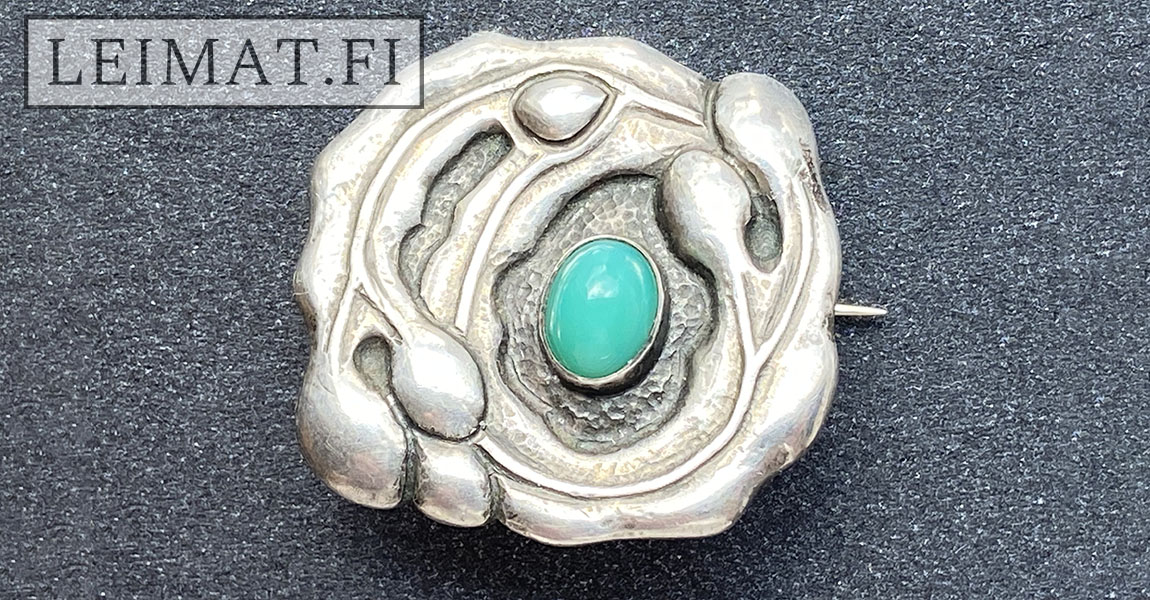
The brooch depicts bladderwrack. The green stone is probably chalcedony. The brooch measures approximately 3 cm.
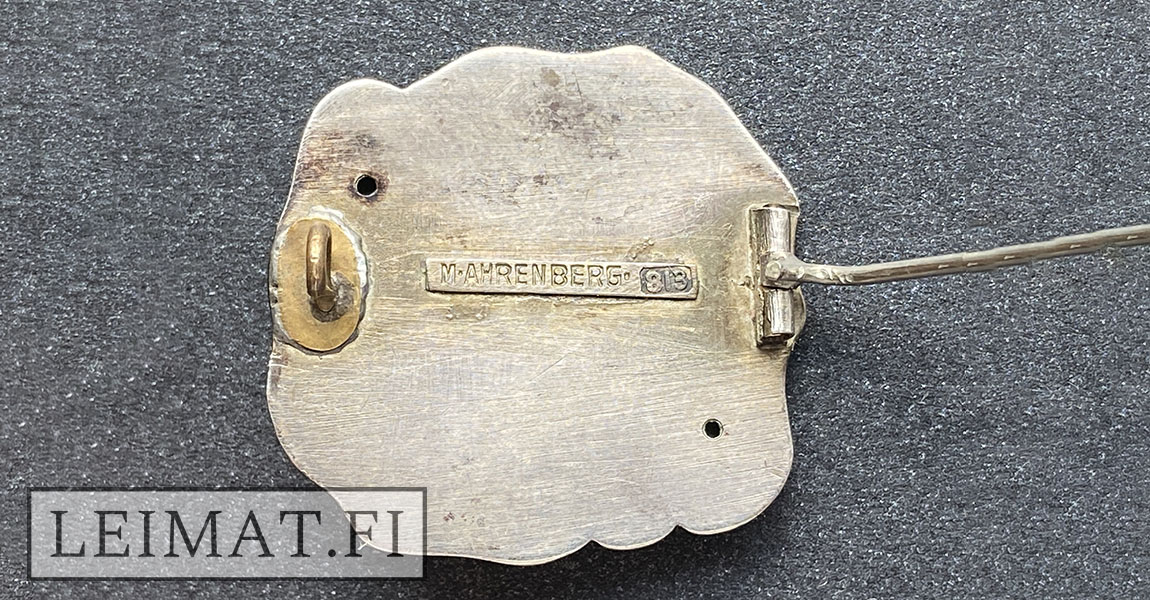
The marks on the brooch. The fastening loop has been repaired at some point.