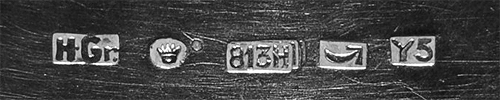
A control mark shows that a precious-metal article has been inspected. Its shape helps date the object and may indicate whether it was imported into Finland or intended for export.
The control mark used in Finland has changed several times. First compare the mark on the object with the periods below, then examine the complete sequence of marks.
Date the mark
Periods of use for control marks
Periods of use for control marks in Finland
Mark
Period of use
Alderman's zigzag
1689–1754
Three crowns
1754–1809
One crown
1810–2021
Oval import crown
1925–1998
Angular export crown
1974–1998
CCM mark
From 1975
Examine the complete sequence
Examples of control marks
The responsibility, locality, fineness and year marks around it help confirm the identification.
Alderman's zigzagTurku year mark for 1742, Turku locality mark, Jonas Lexell and the alderman's zigzag.
Three crownsSwedish–Finnish year mark for 1781, three-crown control mark, Turku locality mark and the responsibility mark of Anders Törnqvist the Elder.
One crownSingle-crown control mark, Olof Robert Lundgren's responsibility mark, the year mark for 1852 and the Turku locality mark.
Oval import crownHugo Grün & Co Oy's responsibility mark, oval import crown, 813H silver fineness mark, Helsinki locality mark and the year mark for 1928.
CCM markThe CCM mark appears first in the sequence. In addition to domestic marks, a precious-metal article may bear the Common Control Mark (CCM) under the Vienna Convention.